Showing posts with label miscellaneous. Show all posts

Monday, March 7, 2011

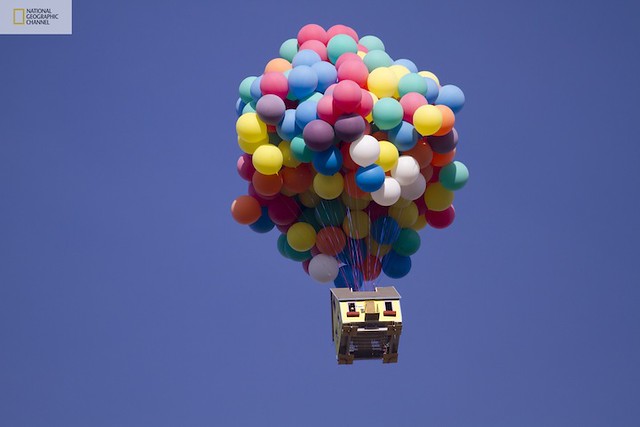
National Geographic recreates the balloon house from Pixar’s Up

NationalGeographicChannel9

This made me unexpectedly happy this morning.  National Geographic has recreated the balloon house from the Pixar movie Up.  How cool is that?  Apparently this is for a new TV show on the National Geographic channel How Hard Can it Be? which will premiere in fall 2011.

No word yet on whether they also plan to recreate the talking dog from the movie.


via My Modern Met, Gizmodo and National Geographic.

Wednesday, February 16, 2011

The Ever Shrinking Chicago - Census Results

IMG_0583

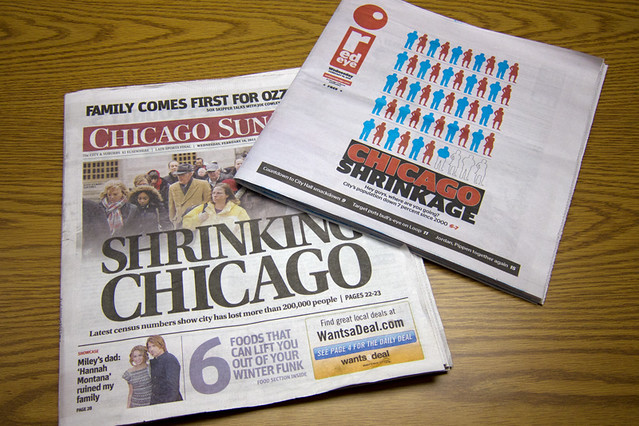
One of my favorite past times while riding the L is to read the random newspapers and magazines that people leave lying on the seats.  Lord knows, I would never pick up a copy of the Red Eye otherwise, and I rarely read the Sun Times.  I find that I learn a great deal about local news this way.

Today’s headline is that Chicago has lost more than 200,000 people over the last decade, according to the most recent census data that’s been released.  I find that kind of fascinating, because this same time period (2000-2010) also coincides with one of the largest building booms in the city’s history.  I think it’s a testament to how much the housing bubble truly was a bubble, that all this construction occurred at a time when the city, it turns out, was losing residents.

Apparently the largest losses were in the African American community, and particularly middle class African Americans, many of whom have fled to the south suburbs.  The Sun Times points to the destruction of Cabrini Green and other public housing projects for this loss, but this doesn't entirely make sense-- middle class African American's were not living in public housing.  Regardless, this is not a good statistic for the African American community or the city as a whole.

Here's how the demographics break down (from the Sun Times):

White non-hispanic: down -5.8%
Black or African American: down -16.7%
Hispanic or Latino: up +3.3%
Asian: up +16.8% (still only 5% of the population though)

Our total population dropped -6.9%, erasing gains made in the 1990s when the population of the city increased by 4%.  Of course, we still have 2.6 million people living in the city limits, so it's not like Chicago is becoming a cow town.

Interestingly, the outer suburbs are booming, with cities like Round Lake and Plainfield having over 200% population growth.  Really, Plainfield?  To each his own.

Further reading: Chicago Sun Times, Chicago Tribune.

Now, for no reason in particular other than it fits the shrinking theme, I'm including a photo of the model train set at the Museum of Science and Industry, showing part of the Loop:

mini lake street

Photo Details: Nikon D50 with Nikkor 50mm f1.8 lens, 1/100sec at f2, ISO800.  Taken in 2007.  The top photo was taken with a Canon S95.  I carried the two newspapers off the train with me and photographed them on my desk.
Wednesday, September 8, 2010

Chicago rated as 8th most stressful city

thru the fence

Chicago has been rated as the 8th most stressful city in the US, according to the Sun Times and an article at Portfolio.com.  I don't have a lot to add to this-- just thought it was interesting and wanted to share the links.  Portfolio provides a PDF which breaks down all the stats.  Detroit and LA are #1 and #2, New York is #6.

Photo Details: Nikon D50 with 18-70mm lens.  This was shot in 2007 in the west loop.  I'm not really sure it's "stressful", necessarily, but it is one of my favorite photos, so I thought I'd use it again.

Sunday, August 22, 2010

Sorry Wired, the Web isn’t dead, just your integrity

I have a friend who's fond of saying that things are "dead to him".  It's become a sort of catch phrase between the two of us-- a bit of over-dramatic silliness-- to represent something that we've grown tired with.  For example, the Chicago White Sox, after losing 2 games to Kansas City this weekend, are most definitely "dead to me".  At least until tomorrow.

So I've come to be pretty skeptical whenever I hear that something is dead, and that's the attitude I took into Wired's cover story this month: The Web Is Dead. Long Live the Internet.

I sighed when I saw that headline.  The basic premise of the article is okay: that more and more people are accessing the internet through smart phone and iPad apps, watching video through Netflix on their Xbox's, or sucking up bandwidth with peer to peer applications.  In other words, using a closed application instead of a web browser to get information over the internet.  Fair enough.  But to say that the web is dead, or even in decline, is just not accurate.  Check out this chart that Wired provides:

Wired1
(Since the web is dead, I assume Wired won't mind me posting this on my web site)

See that, web use is going down!  Well, not really.  Here's the problem with that chart: The left and right sides aren't actually equal.  Or even remotely equal.  We're talking about the dial up internet circa 1990 vs the broadband internet of 2010.  The graph should actually look something like this:

Wired2

Also, note how video is grabbing a larger percentage in both versions.  What's not mentioned by Wired is the fact that video is inherently a bandwidth heavy operation.  Streaming an HD video is simply a lot more data than loading someone's Blogger or Flickr page, or even a decent sized e-commerce site.  So it's neither surprising nor very interesting that video is taking up a growing percentage of internet traffic.  Internet traffic doesn't mean "more personal time spent", it just means more data consumed.

In the end, all of this seems like much ado about nothing.  Just as anyone who overheard me claiming the White Sox were "dead" might question my sanity, Wired looks silly here.  @Wired: you were supposed to use your inside voice with that headline, not put it on the front page!  Sure, smart phones are exploding in popularity, and with them people will access the internet in a wider variety of ways.  But we're still going to have computers at home and in our offices, and barring some mass apocalypse where giant robots take over the planet, that's not going to change any time soon.  The web isn't dead, it's just settling in for the long haul.

Wednesday, June 2, 2010

Lego Printer Uses Felt-Tipped Pens, Tiny Workers


That's one seriously geeky printer.  I'm in awe that someone spent the time to build this, with a working print driver and everything.  Oh, sure, you say, it doesn't print photographs or handle small text all that well, but just think of all the money you'd save on inkjet cartridges!

Via Wired.

Tuesday, March 30, 2010

Professional Photography Shrinking according to NY Times

The New York Times has published an interesting article about how professional photographers (and in particular, editorial photographers) are getting squeezed out of business in the digital era:

"Amateurs, happy to accept small checks for snapshots of children and sunsets, have increasing opportunities to make money on photos but are underpricing professional photographers and leaving them with limited career options. Professionals are also being hurt because magazines and newspapers are cutting pages or shutting altogether."


It's actually worse than that.  Many amateurs are willing to give away their work for nothing, happy just to see their name in print (aka: Capture My Chicago, and other sham photo contests that take advantage of people's vanity).

Don't get me wrong-- I love digital photography.  I've become a much better photographer since switching to digital five years ago, and I love the enthusiasm of people I know on flickr and elsewhere.  But there's no denying that the rise of digital has had significant ramifications for photography as a profession.

Monday, March 22, 2010

I hate mail in rebates!

I hate mail in rebates.  In my opinion, they're little more than a scam to make products look cheaper than they actually are.  The manufacturers know that a certain percentage of customers will never mail in their rebate form, or mail it in too late, thus saving them money over the item being sold with a regular sale price.  Mail in rebates also allow companies to inflate their sales figures towards the end of a fiscal year, by deferring the rebate payouts to the following year.

I bring this up because I recently received a mail in rebate for an Epson R2880 printer that I purchased last November:

EpsonRebate

Note that I said "purchased last November".  It's now the middle of March and this just arrived.  Almost four full months later.  Good god, that's... slow.  I had pretty much forgotten I was even owed this money.  It's like monopoly money at this point.

Fortunately, the printer is fantastic, so I really can't complain too much. 

Hey, maybe I'll spend that rebate check on some paper!

Friday, March 12, 2010

Nikon D90 Pink Edition

If you've ever been curious what a Nikon D90 would look like in a more, er, feminine color, I suggest you watch the video below and find out.  This comes from DigitalRev dot com. 

When I first saw this video my reaction ranged from "Hey, that's my camera"... to... "NO! DON'T DO THAT!"... to... "oh, that's kinda funny."

Friday, January 22, 2010

Lollapalooza From Above (via Google Maps)

While doing some random Google Maps browsing today, I noticed something odd in Grant Park: swarms of people, like a giant ant farm in the middle of the city.  Evidently the satellite photos haven't been updated since last summer's Lollapalooza:

lolla-above

If you've ever wondered what a giant music festival looks like from above, here's your chance.  Who knows how often this gets updated.

UPDATE: as noted in the comments, these images are actually from 2007.  I guess Google updates their satellite photos even less often than I thought.

Thursday, December 17, 2009

Using the term "professional" lightly

This comes via Imaging Resource:

"More than a third of UK marketing, PR and publishing professionals (37%) admit to using images illegally from the Internet. A survey of UK creative professionals by Deutsche Telekom's online photo agency, Polylooks.co.uk, found that not only do a great many creative professionals use images from the Web without paying for the rights, but additionally, most do not understand the meaning of the terms 'royalty free' and 'rights managed'."

To be fair, this was based on a survey of only 200 people, but how do you call yourself a professional and not know how to obtain images legally?  That's just pure laziness.

Monday, December 14, 2009

Kevin Spacey has indigestion, also likes the Olympus Pen.

Olympus has introduced a new series of ads for the PEN Cameras, featuring none other than Kevin Spacey waxing poetic about photography.  I've been impressed with Olympus' marketing of the PEN until now, and truth be told, the new ads aren't bad (hey, at least they don't feature Ashton Kutcher!).  But this one is just too much:


That "hurty" thing?  That's called indigestion, Kevin.

You can see another one at DPReview, which I find entertaining for the fact that Kevin Spacey appears to pull a lens out of his back pocket.

Thursday, December 10, 2009

Camera Sufficiency

"There definitely are types of photographs that gain meaningful artistic power from increasing technical perfection, but many, many, many pictures do not, or at least not much. The things I'm interested in making pictures of fall mostly into the latter category, and I simply don't care about 1 or 2% differences in distortion or 50 line pairs of resolution this way or that."

The quote above comes from Eamon Hickey's excellent review of the Olympus E-P1 over at the Online Photographer.  I think that people on the web (myself included) often forget that in our quest for more, more, more! with our cameras, and it's worth remembering from time to time that more isn't always required.

Eamon also talks about the "advantages" of shooting with an LCD screen instead of a viewfinder, which I suspect many photographers will take issue with.  I personally prefer to hold the camera to my eye-- that's how I've learned to take photos-- but for street photography, I can see the logic in using a small camera and an LCD screen, and Eamon correctly points out that you draw less attention to yourself that way.

Wednesday, December 2, 2009

Falling Water Lego

Looking for a perfect gift for that hard-to-buy-for architecture buff?  How about a Lego version of Frank Loyd Wright's famous Falling Water building:

legofallingwater

Or, if you prefer a gift that's more Chicago themed, check out the John Hancock Center or Sears Tower Legos (and thank you Lego, for still calling it the Sears Tower!).  Sadly, there's no Pritzker Pavilion or Bean Legos as of this writing.  Dare to dream.

Update: In other Lego news: check out the LEGO CAMERA.

Sunday, September 27, 2009

Cameras don't matter! No, wait, they do!

I can't decide who is more annoying this week: equipment whores (ie: photographers who believe that only the most expensive camera equipment is worth buying), or the "cameras don't matter" contrarians.  The former category can best be summed up by the growing chorus of internet chatterers, on blogs and in message boards, who have decided that everyone should switch to "full frame" DSLRs.  Nevermind that most people don't even know what the difference is.  The later, by the likes of Ken Rockwell and others, who has apparently now decided that a toy camera or an iphone is all anyone needs.  Well, I don't agree with either camp.

The truth is, your camera either matters or doesn't matter, depending on what you intend to do with it.  For example, if you're a) shooting everything in daylight, b) you don't particularly care about depth of field, and c) you don't plan on printing anything larger than 8x10, then it probably doesn't matter whether you have a cheap point and shoot or a DSLR.  Also, if you prefer the look of a toy camera or an iphone, then either the camera doesn't matter, or it does, because you will actually need that particular camera to get that particular look.  Photos from a Holga do not look the same as photos from an iphone, which do not look the same as photos from a Nikon D90.

For me, it matters that I have a camera that shoots effectively at ISO800, because I take a lot of photos handheld in dim lighting, and I want my photos to have as little noise as possible.  For that same reason, it also matters that I use lenses that either have a good VR system, or fast apertures (or both).  So I need a good DSLR and at least semi-professional lenses.  What doesn't matter to me is whether the camera is "full frame," half frame, or records photos in the fourth dimension: so long as it gets the job done otherwise.  The needs of your hobby, art, or profession may differ from mine.

The problem is that both sides take their arguments too far.  A full frame camera is not some panacea that will make your photography better.  No amount of gear can make up for bad technique or a poor composition.  At the same time, anyone who argues that the camera doesn't matter AT ALL has clearly never tried to do sports photography, or astral photography, or anything else remotely specialized with an iphone.  To argue that the camera doesn't matter at all is just silly talk.  It does.

Note: this blog post was partially inspired by my friend egophony.  Also, insomnia and a large cup of green tea.

Saturday, August 22, 2009

Is Capture My Chicago a good deal for photographers?

I'm posing that title as a rhetorical question.  I don't think it is, but I'd love to hear what others have to say?

Capture my Chicago is a photography contest / social networking site / fine art book in the making.  It's a collaboration between CBS 2 Chicago and Pediment Publishing, which has published other books in this model, such as "Capture my Colorado" and "Capture Cincinnati".  In essence it works like this: you submit photos to their web site, the photos get voted on by the other users of the web site, and ultimately some combination of the highest vote getters and the editor's choices make it into the book.  Capture my Chicago isn't paying the photographers anything, although a select few will receive prizes-- all they're really offering is exposure and credit in the book and on the web site.

I found out about this after someone left a comment on my flickr stream.  I have to admit that it's a clever idea, but after some thought I've decided not to participate.  While I've submitted photos to contests before, and been published without payment (ie: the Chicago Reader last year is a good example), I draw a distinction between a local, free publication and a fine art book that will be sold for $39.99 at your local Barnes and Noble.  I think that pushes the boundaries of what can be considered in good faith a contest.  Capture My Chicago intends to publish a book with 100-250 photos.  Let's say that 150 photographers take part-- only 18 of those people are getting paid anything in the form of prizes.  They're not even giving the contributors a free copy of the book-- you have to buy it yourself!

JPEG magazine has been doing a similar, user generated publication for years now, yet they manage to pay each photographer $100 bucks.  That's always seemed fair to me. 

In the end, I guess this boils down to what one expects out of their photography?  For many people, I imagine the exposure of being in the book is enough.  And if that's the case, please don't let this blog post rain on your parade.  To each his own.

Friday, May 22, 2009

Kobe and Me (a flickr stats love story)

kobe

This is the second most viewed photograph on my flickr account.  It's losing out only to this photo of the Bean, and is beating many, many excellent shots, including this one.  Since I first posted it in 2006 it has been viewed an astounding 2,474 times, and just today has already received 21 views.  I know this because of flickr's extremely addictive stat tracking system, which not only tells you how many hits a particular photo is getting, but in many cases where those hits are coming from.

I find this all rather amusing, because to be honest, I don't think it's a very good photo!  In fact, were I to take this one in 2009, I'm not sure if I would even post it on flickr (or at least I would process it better-- it looks a bit flat to me).  Rather, the reason this shot gets so many views is because I titled it "Kobe" and the word "house" appears in the description and the tags.  You see, apparently there's a lot of interest on the internet for "Kobe Bryant's House", and people have been unwittingly drawn to this shot after doing a Yahoo image search.

For the recond, this is actually a photo of the Humboldt Park lagoon in Chicago and the Humboldt Park boat house, with some random guy in a Kobe Bryant Jersey.  Kobe Bryant, I'm fairly sure, does not live in Humboldt Park nor fish in this lagoon.

Finally, as an aside... Go Nuggets Magic!

Tuesday, March 17, 2009

Trump Tower Crane Photography by Ken Derry

I happened to be flipping channels last night when I came across a story on Chicago Tonight about Ken Derry, a local tower crane operator & amateur photographer.  Ken spent 36 months working the tower crane for the construction of the Trump Tower and captured some truly unique images on the way up.  The whole set (over 500 photos) can be viewed at his smugmug account.  Here are two of my favorites:

Photo by Ken Derry

Photo by Ken Derry

He has quite a few photos like the second one, looking down at the city engulfed in clouds.  The Trump Tower rises over 1300 feet (including its spire), and is the second tallest building in Chicago after the Sears Tower.

Ken also took photos of the construction crew working on the tower, such as this one, which reminds me a little of Lewis Hine's photographs of the Empire State Building under construction in the 1930s.  Now, I don't want to push that comparison too far-- the Trump Tower is no Empire State Building.  Nonetheless, it's now part of the Chicago skyline and is going to be here for a very long time.  So will these photographs documenting its rise.

In the Chicago Tonight interview, Ken said that he plans to put out a coffee table book in the future.  In the meantime, please visit his smugmug site and buy one of these photographs if you like what you see here.

Tuesday, March 10, 2009

Olympus Exec Declares Megapixel Race Over, The Internet Agrees.


LAS VEGAS--Olympus has declared an end to the megapixel race.

"Twelve megapixels is, I think, enough for covering most applications most customers need," said Akira Watanabe, manager of Olympus Imaging's SLR planning department, in an interview here at the Photo Marketing Association (PMA). "We have no intention to compete in the megapixel wars for E-System," Olympus' line of SLR cameras, he said.


Source: news.cnet.com

I first noticed this article mentioned last week at The Online Photographer and then again today at Engadget.  I didn't pay much attention when I first saw it.  While I agree with Mr. Watanabe, it's also a self serving statement.  The 4/3rds sensor used in Olympus DSLRs is smaller than the sensors used by the other major camera companies.  Realistically Olympus just doesn't have as much room for pushing the megapixels higher, even if they wanted to.  (See this page for a comparison of different sensor sizes).  Still, at least in terms of the compact camera market, the megapixel race has clearly gotten out of control, and in most instances has actually hurt image quality instead of improving it.  So kudos to Olympus for being honest.

What I find interesting about this story is that the majority of people on the internet seem to agree with him (if the comment sections are any indication).  I was especially surprised when I saw this at Engadget.  No offense to the readers there, but most of them are not serious photographers and are probably not reading photography specific blogs.  So this tells me that reality is getting through to the general public.  More megapixels will make your images bigger, but not necessarily better.

Monday, February 23, 2009

Ritz Camera files for chapter 11 bankruptcy

Ouch:

Ritz Camera Centers, the nation's largest retail photography chain, has filed for Chapter 11 bankruptcy protection.

The Beltsville, Md.-based company submitted its filing Sunday in federal bankruptcy court in Wilmington, estimating assets and liabilities at between $100 million and $500 million. The list of its top 30 unsecured creditors is led by Nikon Inc. and Canon USA Inc., which are owed a combined $40 million in trade debt.


Source: Business Week 2/23/09

No wonder Nikon is raising lens prices!  This is sad news.  There are quite a few Ritz and Wolf Cameras (which are the same company) in the Chicagoland area, and I used to buy prints from a local Ritz.  The Business Week article goes on to discuss how the company has not done well with the transition to digital, losing significant revenue in the once profitable photofinishing business.  This tracks closely to my own personal experience.  I stopped using Ritz for prints years ago, in part because I just don't make that many prints anymore, but also because I've found online vendors (such as MPIX) who do a better job.  Still, it's nice to have a local option that isn't a Target or a Walgreens, so this is disappointing and I hope Ritz can recover.

Wednesday, February 4, 2009

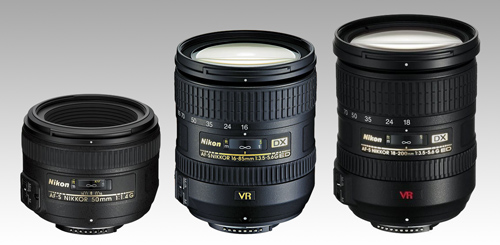
Nikon raising prices in the US

nikonlenses

In what seems like a cruel joke in this horrible economy, prices for Nikon lenses are on the rise.  Three examples that I've noticed this week:

The Nikon 16-85mm is now selling for $599.00 $629.00.  It was selling for $529.00 last week.

The Nikon 18-200mm is now selling for $699.00.  It was $629.00 last week.

The Nikon 50mm f1.4G is now selling for $499.00.  I can't remember an exact price but I swear I've seen that one for as low as $399.00 in the past.

Price increases appear to be even worse for professional lenses, though I haven't been following those as closely.  It's not clear to me what's happening with camera body prices at this point.

As has been noted by Thom Hogan and others on the internet (Nikon Rumors, for example, has been predicting this for weeks), these price hikes are the result of exchange rate fluctuations between the Yen and the Dollar.  In other words, because the value of the Yen has fallen in relation to the Dollar, Japanese manufacturers have little choice but to raise prices in the US in order to maintain profit margins.  While I more or less understand this, I also think it's poor customer relations by Nikon, especially in this current economic climate.  If prices really have to go up, why not issue a press release explaining the situation to your loyal customers?  A little more transparency would be nice.